


One of the hardest things about being a founder is learning to spend your attention where it actually matters. Not where the noise is loudest. Not where the anxiety pulls you. Where you can actually move something.
The framework we use for this comes from Stephen Covey, who introduced it in The 7 Habits of Highly Effective People under Habit 1: Be Proactive. He called them the Circle of Concern and the Circle of Influence. Later leadership writers expanded it into a set of concentric rings, which is the version we teach because it maps more cleanly to how a founder’s day actually looks.
The idea is simple. Lots of things affect you. You don’t have a corresponding ability to affect all of them. Most people spend their emotional energy in inverse proportion to their actual leverage.
Here’s what the circles look like, from the inside out.
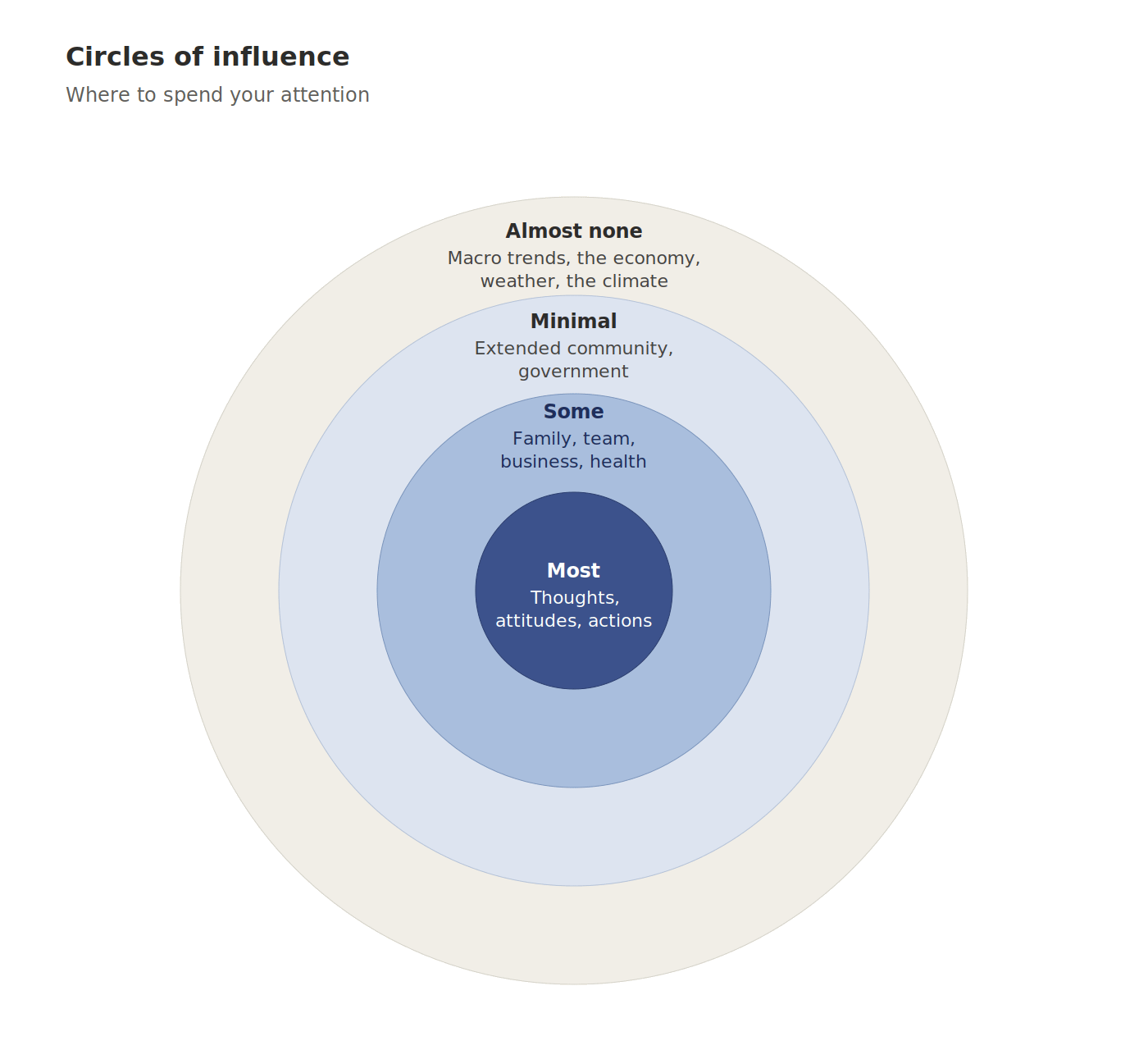
Most influence: your thoughts, attitudes, and actions
The innermost circle is you. What you think. What you feel. What you do. This is where your leverage is highest and where, paradoxically, most founders spend the least time.
Even here, control isn’t total. Nobody controls everything they think. Nobody controls every reflex reaction to a hard email or a bad meeting. The self-aware founder controls more than the reactive one, but nobody controls all of it. Triggers are called triggers for a reason.
But you have more control here than anywhere else in your life. You can change how you frame a setback. You can change what you decide to focus on tomorrow morning. You can change how you show up in a hard conversation. You can decide whether to send the email or sleep on it.
Most of your leverage lives here. Most founders barely tend to it.
Some influence: family, team, business, health
The next circle out is where you have real but partial influence. Your immediate family. Your friends. Your co-workers. Your home. Your business. Your health.
Your business belongs here, not in the innermost circle, and it’s worth pausing on that. You don’t fully control your business. You influence it heavily. You decide what to build, who to hire, how to spend, what to say yes and no to. But customers make their own decisions. Team members make their own decisions. Investors make their own decisions. You are the largest single influence on your company, and you are still not in control of it.
Same for health. You control what you eat, how you sleep, whether you exercise. You do not control cancer. You do not control accidents. You optimize possibilities. You never eliminate risk.
This is the second-highest leverage zone. If you’re doing the work in the innermost circle, this is where most of the visible output shows up.
Minimal influence: extended family, neighborhood, government
The next ring out is where you have some influence but not much. Your extended family. Your neighborhood. Your local government. Your industry ecosystem.
You vote. Sometimes your candidate wins. Sometimes they don’t. You can pick up trash on your street. You can’t paint your neighbor’s house. You can attend a founders’ meetup. You can’t rewrite how your city funds infrastructure.
Founders often get pulled into this ring by frustration. The industry should be different. The city should support startups better. The tax code should favor small companies. All might be true. None of it is where your leverage sits.
Contributing to change at this level can be meaningful and worthwhile. It should not be where most of your attention lives.
Almost no influence: macro trends, the economy, the climate
The outermost ring is where you have almost no influence at all. The price of oil. Interest rates. The venture funding climate. The broader economy. Weather. Climate. War and peace. The general vibe of the market.
You have some second-order influence. You recycle. You vote. You choose what to consume. Your individual actions do matter in an aggregated sense, and you should still do them. But the amount of attention founders spend here (in the form of anxiety, reading, doomscrolling, and comparing themselves to a market they can’t control) is wildly disproportionate to their ability to move anything in it.
This is the ring where founder attention gets destroyed the fastest.
Where founders actually lose the game
The specific application to founder life is worth calling out.
You cannot control the venture landscape. You cannot control whether capital is loose or tight this quarter. You cannot control which competitor closes a round next week or how much they raise or which fund led it. You cannot control interest rates, the IPO market, or whether the AI hype cycle inflates or pops.
The number of founder hours lost each year to obsessing over these things is staggering.
What you can control is your pitch deck. Your product. Your sales process. Your team. What you spend time on tomorrow morning. The email you send tonight. The conversation you have with your co-founder about what’s actually working. The people you choose to spend your remaining attention on.
Every hour you spend refreshing TechCrunch is an hour not spent on the circle where you have leverage.
The reframe
This is an attention allocation problem. If you spend 70% of your attention on the outer rings, you get almost no return on it, because your leverage there is close to zero. If you spend 70% of your attention on the innermost two rings, you get most of the possible return, because your leverage there is high.
Same amount of energy. Radically different outcomes.
The founders who endure are those who figure this out. They stop trying to control the macro. They stop measuring themselves against news headlines. They let the ecosystem be the ecosystem and put their finite attention into the tight core of things they can actually move.
That doesn’t make the outer rings go away. The economy still shifts. Competitors still raise. Markets still turn. All of that keeps happening whether you obsess over it or not.
The question is whether your response to those things is going to come from a place of leverage or from a place of reaction.
Focus on the center. Let the edges do what they’re going to do.