


Most founders don’t have a time problem. They have an attention problem, and it shows up as a time problem.
You have eight to twelve productive hours in a day. The question is which of those hours are you doing the work that only you can do, and which are you doing work that is quietly draining you while producing very little. Most founders can’t answer that cleanly. Until you can clearly identify which work produces the best returns, no amount of productivity hacking is going to help very much.
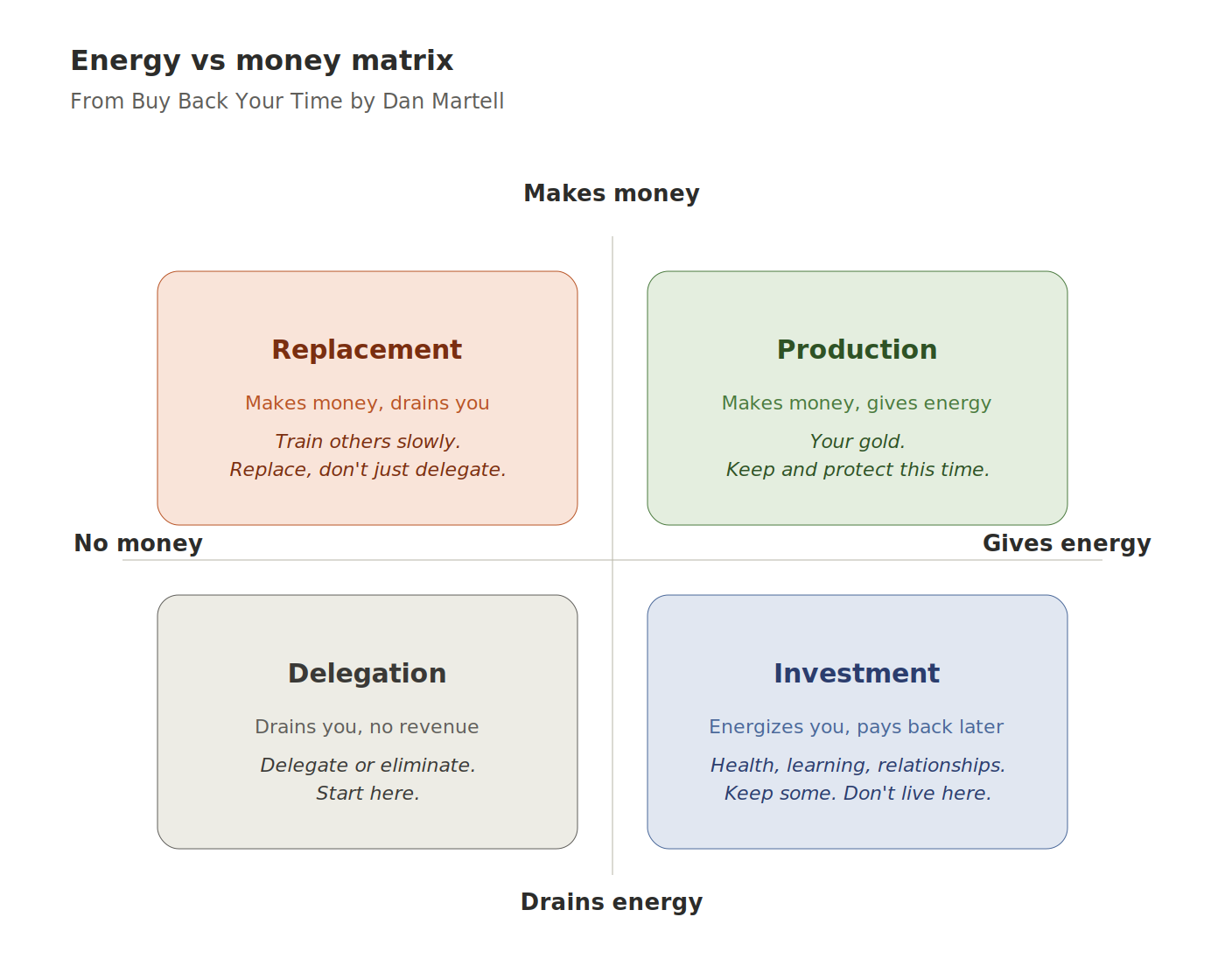
The framework we use for this comes from Dan Martell’s book Buy Back Your Time. If you haven’t read it, it’s worth the time and money. The core tool is a simple 2x2 that maps everything you do against two axes: how much money it makes you, and how much energy it gives you.
Every task in your life sits somewhere on this grid. Where it sits tells you what to do with it..
The delegation zone: the easiest place to start
The bottom left is where most founders should start because it has the lowest stakes and the highest immediate payoff.
The rule is simple. If a task drains you and doesn’t produce revenue, either delegate it, automate it, or stop it entirely.
The elimination path is underrated. Lately, I have been unsubscribing from newsletters I kept “meaning to read” that just built emotional debt in my inbox. If you’re not reading it and it isn’t valuable most of the time, unsubscribe. The same principle applies to meetings that no longer need to exist, reports nobody reads, and processes that persist because nobody bothered to kill them. Cutting is often better than delegating because delegating still requires oversight.
The delegation path is where most founders leave money and hours on the table. The reason is usually that they haven’t tried, or they tried once with a bad hire and gave up.
The virtual assistant unlock
The single highest-leverage move for most founders in the delegation zone is hiring a virtual assistant. Even part-time. Even ten hours a week.
Here’s what it actually looks like in practice. You get an idea for something you want to send out. Normally you’d sit down and spend an hour and a half writing it, formatting it, finding the right people to send it to, personalizing the send. Instead, you spend five minutes explaining the idea to your VA. They come back with a draft that’s 80 to 90% of the way there. You spend fifteen minutes polishing. Total time from you: twenty minutes instead of ninety.
That’s a 4x multiplier on your output for the same amount of your time. Sometimes it’s 10x, depending on the task.
The math gets more interesting when you consider what you do with the freed hours. If you spend them in the production zone, you’re compounding the value. If you spend them on sleep, exercise, or family, you’re compounding a different kind of value that turns out to matter just as much for whether you last as a founder.
We’ve placed fifteen to twenty VAs from Latin America for founders in our network. Why do we recommend LATAM specifically?
The time zones are close to US business hours
The cultural context is closer to a US working environment than most alternatives
The English quality is often stronger than what you get from Eastern Europe or Asia.
Rates typically run $8 to $15 an hour depending on the level of the role.
The roles range widely. Straight administrative VAs. Video editors. Customer service. Business operations. Sales development. Whatever’s sitting in your delegation zone is likely something you can hire someone in LATAM to do for a fraction of what a US hire would cost, and often at a higher quality than you’d expect.
If this is something you want to explore, talk to our team here. We’ll help you scope the role, figure out what to hand off first, and match you with someone from our network.
The replacement zone: the harder work
Once the delegation zone is under control, the harder work begins.
The replacement zone is where founders get stuck. This is the top-left quadrant, the work that makes money precisely because you do it. Maybe you’re the best salesperson in the company. Maybe you built the marketing engine, and it runs on your intuition. Maybe your product intuition is the reason the roadmap doesn’t drift.
The instinct here is to hold on. “Nobody else can do this as well as I can” is technically true and strategically fatal. If the work drains you, holding it means you’ll eventually burn out while doing good work for your company. That’s a worse outcome than an imperfect handoff.
The move is replacement, not delegation. The distinction matters. Delegation is handing off a task and letting the person run with it. Replacement is a slower, deliberate transfer. You document your process, you train someone into it, you stay closely involved during the handoff, and you gradually pull back as they demonstrate competence.
One founder in our network was a marketing genius who decided to hand off marketing entirely. She hired a fractional executive, briefed her, and stepped away. Months later she realized the fractional exec was operating out of alignment with the company. Not because the hire was bad, but because the handoff had been too fast. The job wasn’t just tasks. It was judgment calls the founder had been making implicitly, and nobody had captured them explicitly.
The fix wasn’t to fire the executive. It was to re-engage. Regular check-ins. Explicit conversations about brand voice, positioning, priorities. Slower transfer. What she called delegation had actually needed to be replacement.
If the work makes real money for the company, don’t just hand it off. Replace yourself out of it. That means SOPs, close oversight, and a gradual widening of the trust zone as the new owner earns it.
The order of operations
Most founders try to do this backwards. They obsess over their production zone (which usually doesn’t need optimization because it’s already working), procrastinate on their replacement zone (which is the hardest), and let their delegation zone fester (which is the easiest to fix and the fastest to pay off).
The right order is the opposite. Start with the delegation zone. Get the drain off your plate first. Use the reclaimed hours to properly set up the replacement zone. Protect the production zone with everything you have. Don’t neglect the investment zone because it’s what keeps you functional over the long run.
The whole framework is a tool for one question? Are you using your time wisely?
Most founders find out, when they honestly map it, that the answer is no. And that gap between where their time is and where it should be is where the leverage lives.