


If you want to understand the culture you’ve actually built, not the one you say you want, ask two questions.
How much do you invite your people into your life? And how much do you challenge them to grow?
These two dimensions, plotted against each other, give you a 2x2 that explains more about your organization’s culture than most multi-page values documents ever will.
I learned this framework years ago from some mentors, and I teach it regularly. We’ve never written it down on the Wisdom Partners blog, which is overdue, because it’s one of the most useful diagnostic tools we have. (Shout out to Susan Vick for the prompting to get this published.)
Here’s how it works.
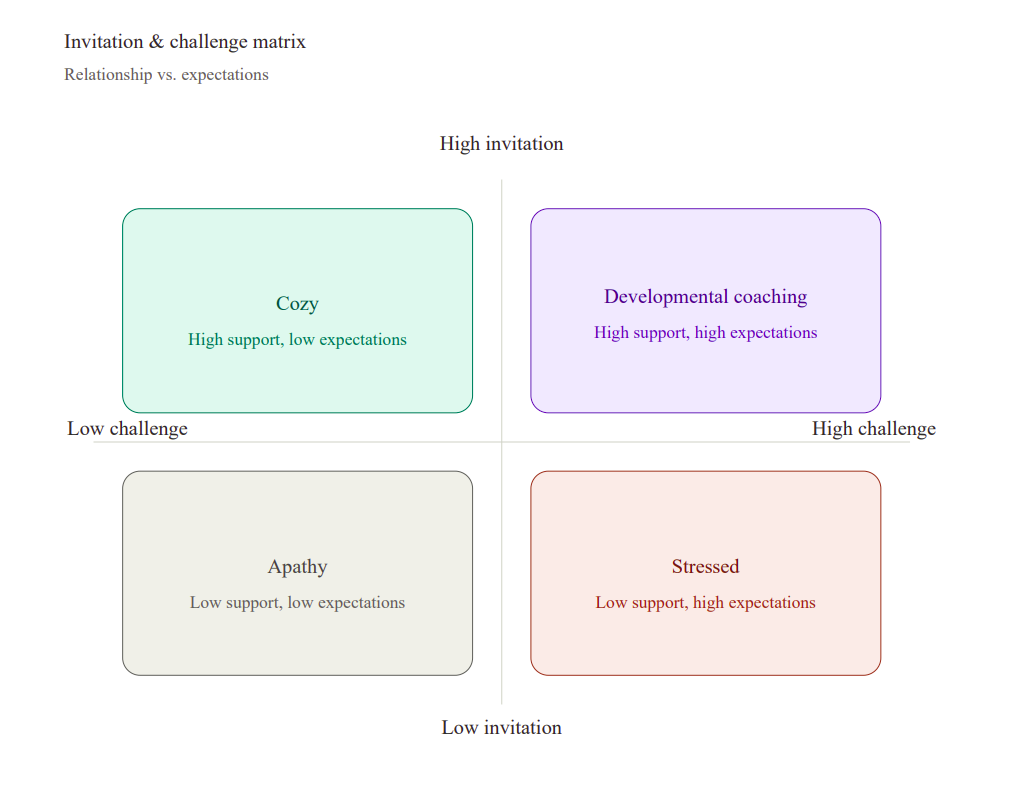
Invitation is the relational dimension. How welcomed do people feel? How much do they belong here? How safe is it to bring your whole self to the work? High invitation cultures feel warm. People know each other. They’re rooting for each other. Low invitation cultures feel transactional. You show up, you do your job, you go home.
Challenge is the performance dimension. How high are the standards? How much are people pushed to grow? Are they expected to do hard things and get better at them? High challenge cultures expect excellence and ask people to stretch. Low challenge cultures don’t expect much beyond showing up.
Cross them and you get four quadrants. Each one is a different kind of company.
Low invitation, low challenge: Apathy. Nobody’s pushing, nobody’s connecting. People show up, do the minimum, and leave. There’s no energy. There’s no growth. Nothing’s really wrong, but nothing’s really right either. This is the quietly dying company. The people who care most are already looking for somewhere else to work.
High invitation, low challenge: Cozy. Everyone’s nice. Everyone gets along. There’s warmth and camaraderie and probably good snacks in the kitchen. But nobody’s getting better. The standards are soft. Hard feedback doesn’t happen because it would feel mean. Underperformance gets absorbed by the team because nobody wants to be the one to call it out. From the inside, this can feel like a great place to work. From the outside, you’re getting passed by competitors who challenge their teams.
Low invitation, high challenge: Stressed. The standards are high but the relationship isn’t there to support them. This is the domineering boss culture. Push, push, push. Hit the number or else. In the short term, it can look productive. People are scared enough to perform. But it isn’t sustainable. The best people leave first because they have options. The ones who stay burn out, or they harden into something cynical.
High invitation, high challenge: Developmental or Coaching. This is the quadrant you want. People know they belong. They also know they’re expected to grow. The relationship makes the high standards understandable, and the high standards make the relationship meaningful. People aren’t just connected; they’re bonded around something hard they’re doing together. This is where the best teams live.
Why this matrix matters
Most founders intuitively understand that pushing your team hard works in the short term. Pressure produces output. The mistake is thinking that’s the whole story.
Sustained performance requires both invitation and challenge. Pull either one out and the system collapses, just in different ways. Without challenge, you get a comfortable team that doesn’t grow. Without invitation, you get a stressed team that doesn’t stay.
The goal is to be the kind of leader who can do both at the same time. Care deeply about your people and hold them to a high standard. Make them feel welcomed and expect them to stretch. Be warm and be honest about what isn’t working.
That combination is rare because the two pulls feel contradictory. High invitation feels like softness. High challenge feels like harshness. Most leaders default to one or the other based on their temperament, and end up in the cozy quadrant (if they’re naturally warm) or the stressed quadrant (if they’re naturally driven).
The work is to hold both at the same time. Care about the person and refuse to lower the bar for them. That’s not a contradiction. It’s the actual definition of coaching and healthy leadership.