


There’s a version of early-stage building that looks disciplined on the outside and is actually just fear in a sports coat. Perfect plans. Big launches. “We’ll ship once it’s ready.” A thousand tiny decisions designed to avoid the only thing that matters: getting real signal from the market and staying in the arena long enough to compound it.
This week’s two Founder Real Talk episodes land on the same uncomfortable truth from different angles: founders don’t lose because they aren’t smart. They lose because they either stop moving or move without a learning system.
Connor Engelsberg (Orvyn): The Real Differentiator Isn’t IQ. It’s Failure Tolerance + Memory
Connor’s episode is the technical founder’s version of the same principle: progress is less about brilliance and more about how much failure you’re willing to metabolize.
Orvyn is solving a problem that sounds small until you’ve lived it: finance PowerPoints that need to be perfect, going through a dozen to two dozen iterations, where “tiny” changes consume hours or days. Their promise is brutal and clear: take that crank-turning work and compress it into minutes.
But Connor’s most founder-relevant insight is what it took to get there. PowerPoint is a terrible substrate to build on. There’s no clean playbook. For months, they couldn’t even get to the point of putting it in users’ hands. He describes it as “death by a thousand cuts”; not one cinematic failure, just repeated tries, glitches, workarounds, and restarts.
That’s where his advice lands: the thing that matters most is how willing you are to fail and try again. Not intelligence. Not credentials. Not vibes. Endurance.
Luke Miller (MediaRide): Speed Wins When You’re Buying Signal, Not Status
Luke’s most valuable founder lesson isn’t “move fast.” It’s why moving fast matters: because it’s the only way to buy signal before you burn months on assumptions.
He’s seen the founder pattern a hundred times: a company shows up wanting a “big, grandiose deliverable”; the flagship brand video, the perfect polished piece, the expensive thing that feels like progress. Luke slows that down and pushes them smaller: faster deliverables, quicker iterations, more reps. Not because he’s conservative, but because he’s optimizing for learning.
Here’s the strategic move founders miss: marketing should behave like product development. Your job isn’t to create the best artifact. Your job is to build the fastest learning engine. Small deliverables create feedback. Feedback creates clarity. Clarity compounds into positioning and pipeline.
Founders also need to watch out for the quiet killer that shows up right when things start working: ICP drift. When cash is coming in, it’s tempting to say yes to “almost right” clients and “close enough” projects. Luke learned (again) that saying yes this week can cost you the next quarter. Six months later you realize you’ve been building work you don’t want, for customers who won’t refer you, in a way that muddies your positioning.
And he ties it all to founder capacity. When you’re sprinting nonstop, your judgment degrades. You take the wrong work. You overbuild. You overthink. Luke’s shift wasn’t just better strategy; it was building the recovery habits that let him execute strategy under pressure.
Momentum Is Only Real When It’s Paired With a Learning System
Luke and Connor are describing the same operating system from two different founder worlds:
Luke is on the market-facing side: don’t bet months on one perfect deliverable; ship smaller, learn faster, stay inside your ICP.
Connor is on the build-facing side: hard products require endless failure; the edge is staying in it and remembering what the failures taught you.
The shared lesson is not “hustle.” It’s not “grit.” It’s more specific:
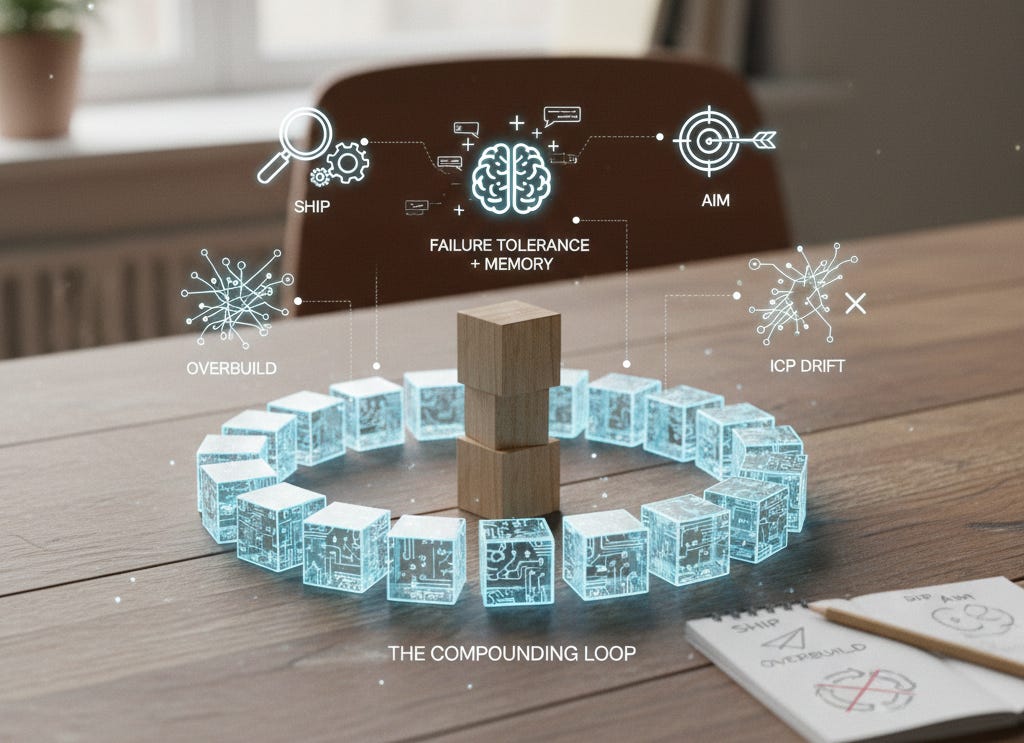
Your company grows when you can run a high-velocity loop without losing coherence.
That loop has three parts:
Ship something small enough to learn from quickly
Reflect in a way that changes future behavior
Aim that loop at the right customer
Most founders break the loop in predictable ways:
They overbuild because they’re afraid to ship.
They ship randomly because they’re afraid to choose.
They “learn” but don’t institutionalize it, so they repeat mistakes.
They chase cash that doesn’t match their ICP, and then wonder why growth feels chaotic.
If you want a simple founder KPI for this week: How quickly can you run a cycle that makes you smarter?
Listen + Subscribe
If you’re building in the messy middle, these two episodes are a reminder that the game isn’t perfection; it’s compounding learning.
And if you want more founder-to-founder lessons like this each week, subscribe to the Founder Real Talk Channel on YouTube or Spotify so you don’t miss the next episode.
