


The founder version of autonomy is: freedom to do whatever I want. That definition makes sense for founders because founders are people who couldn’t handle having a boss. They started a company partly because they have a strong internal compass and don’t want to distort it to fit somebody else’s vision.
That is not what most employees mean when they say they want autonomy.
What they actually want is the freedom to execute on your vision without having to come back to you for every decision. They want to achieve the outcome you’re trying to achieve, in the direction you’d choose, using the judgment they’d apply if they had your context. What they’re asking for isn’t independence from you. It’s the ability to represent you when you’re not in the room.
That distinction is nearly the whole game. Miss it and you’ll either micromanage a team that resents you, or over-delegate to a team that quietly drifts away from what you actually wanted.
The three layers
Every decision inside your company happens across three layers.
The why. Why are we doing this at all? What outcome are we ultimately after? What’s the mission we’re trying to serve?
The what. What specifically are we going to build or ship or do this quarter? What does success look like? How will we measure it?
The how. What tactics are we going to use? What tools? What sequence? What compromises are we going to make when reality doesn’t fit the plan?
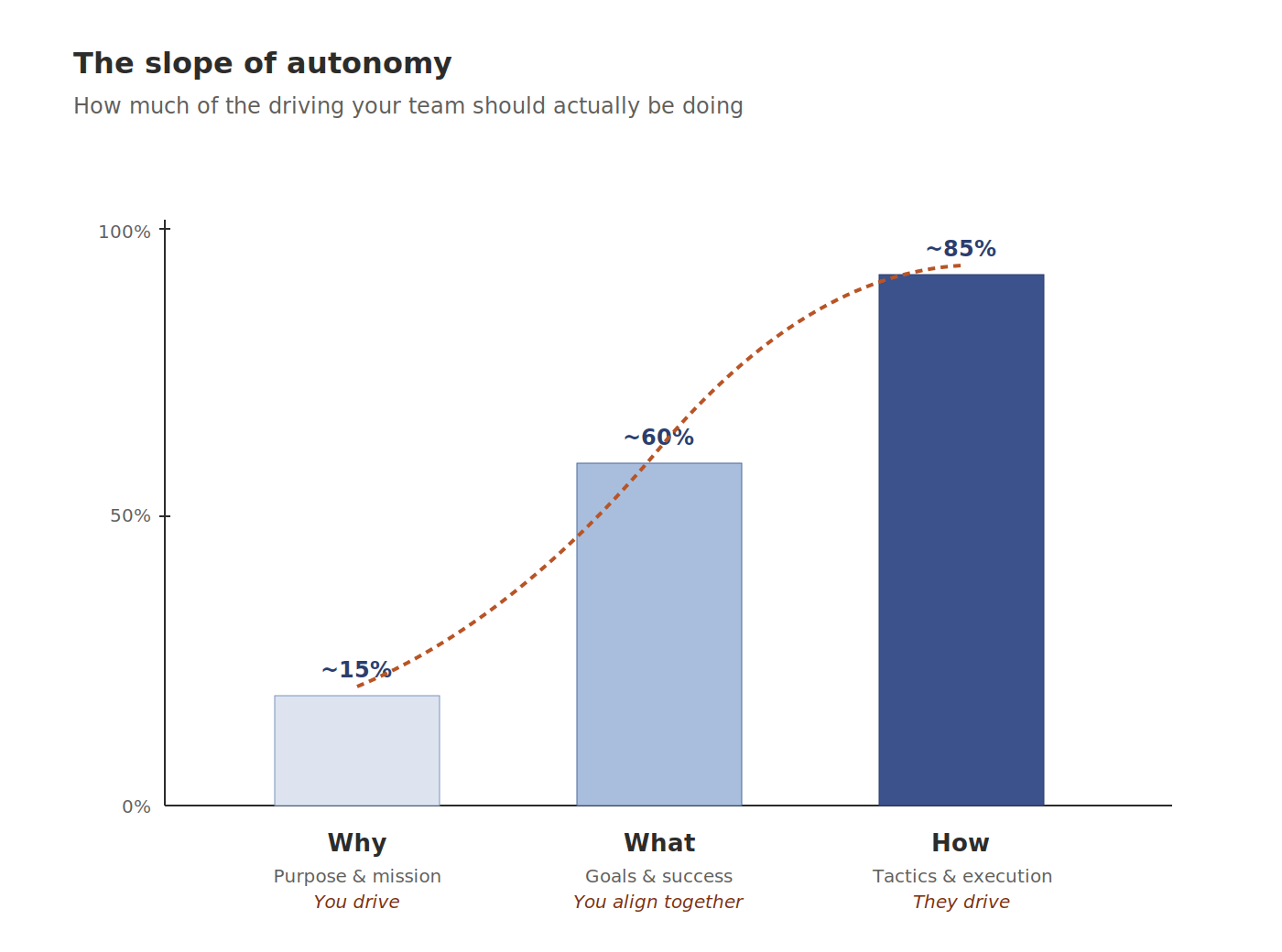
These are not the same layer, and they shouldn’t be owned the same way. Real autonomy is a slope across these three, not a single toggle.
Layer 1: the Why (You drive 80 to 90 percent)
This layer belongs to you.
Your team wants you to own the Why. That’s why they took the job. They want to be part of something bigger than themselves, and they want you to tell them what the bigger thing is. Imagine how they would feel if you show up to the Monday all-hands and say, “So … what do you all think we should be trying to accomplish?” You have not empowered them. You have destabilized them.
They will contribute some to the Why—especially senior leaders, who should have real influence at this layer. But even the strongest senior leader wants to know that the founder has a view, believes in it, and is willing to defend it. A senior VP will happily help refine a Why, but they want it to be a real thing they’re reshaping, not a blank canvas.
The more junior an employee is, the more they want the Why to come from you, whole and unambiguous. This is the layer where founder clarity matters most.
Layer 2: the What (Roughly split: they draft, you refine)
This is where most leaders get it wrong, in either direction.
The command-and-control mistake is to hand your team a fully specified what. “Here are our quarterly goals. Here are the KRs. Go execute.” You’ve saved yourself a week of team-based planning … and destroyed any sense of ownership in the process. Your team is now compliant (hopefully), but not aligned.
The hands-off mistake is to say, “Figure out what we should be doing this quarter.” Then, you get frustrated when they come back with something that isn’t what you had in mind. You didn’t share your view. They aren’t mind readers.
The right move is a feedback loop. You share the Why in specific enough terms that direction is clear. You ask them to come back with What they think the what should be, given that Why. They draft it. You react, ask questions, push back where you disagree, help them see what they missed. You iterate until you’re both aligned.
At the end of that process, they’ve done maybe 60 percent of the driving on the What. You’ve done 40 percent, mostly through course-correction rather than dictation. And critically, they now own the What because they proposed the majority of it, even though your fingerprints are all over the final version.
This is the layer that carries the most weight, because it’s where alignment actually gets tested. If you get this layer right, the layer below almost takes care of itself.
Layer 3: the How (they drive 80 to 90 percent)
Once you’re aligned on the What, the How belongs to them.
You are not the tactician on their function. You hired them because they know things about execution that you don’t, or because you don’t have the time to be in the details. Either way, the How is their zone.
Your job at this layer isn’t to prescribe. It’s to observe. You look at how they’re executing not to correct their tactics, but to check whether their alignment on the What and the Why is actually solid.
Here’s the reframe. When an employee’s How is off, the problem is almost never that they’ve chosen bad tactics. The problem is almost always that you weren’t as aligned on the What or the Why as you thought. Their tactics are the diagnostic. What they choose to do reveals what they think you’re actually trying to accomplish.
If a new sales leader comes back with a hiring plan that focuses on a region you never intended to prioritize, the right question isn’t: “Why are you hiring in the wrong region?” The real question is: “What do we not agree on about where our sales team should focus?” Their How is telling you that your What wasn’t actually shared.
Fix that upstream, and the tactics correct themselves.
The shape of the slope
Put together, autonomy across a healthy leader-employee relationship looks like a curve rising from left to right.
At the Why, they have a voice, but you’re driving. At the What, they draft, you refine, and you converge together. At the How, they’re in the driver’s seat, and you’re watching for signal.
That’s the slope of autonomy. That’s what employees mean when they say they want autonomy. Not independence from your direction. Ownership over the parts of the work where their expertise is the point.
The founders who get this right report something interesting once it clicks. Their team starts spending real cognitive effort building a mental model of them. What would the founder say about this? How would they weigh these two options? What would they push back on? It’s like your personal chatbot within their minds.
Your team is doing this whether you want them to or not. Most founders don’t realize how much of their team’s time gets spent on this specific kind of prediction. The move is to shape that prediction deliberately, so the version of you living in your team’s heads is accurate enough to answer questions when you’re not there.
That’s the actual mechanism of scaled leadership. Not more meetings. Not more oversight. A team that can predict your judgment because you gave them enough alignment to build a working model of it.
The slope is a diagnostic. Wherever your team feels stuck, look at the layer before and ask whether you actually did the alignment work there. Almost every time, the answer is that you didn’t do enough of it.
Build the slope. The autonomy follows.