


For most founders, “strategic planning” feels out of reach. Thinking of 3 or 5-year plans feels like looking for animal shapes in the clouds. You can kind of see it if you squint, but not really.
Don’t get me wrong. It’s helpful to have a vision for how you want to change the world. But making actual plans is different. Even one-year plans can feel too far in the future to make much sense for fast-moving startups.
Start with a solid, short mission statement.
A few weeks ago, we wrote about why your mission statement is probably useless. Short version: most missions are too long, too generic, and too forgettable to actually guide decisions. If yours is more than five to seven words and your team can’t recite it from memory, start there.
This post assumes you’ve done that work. You’ve got a mission that fits on one line and actually directs behavior. Now what?
Now you set goals. And this is where most founders fall apart again.
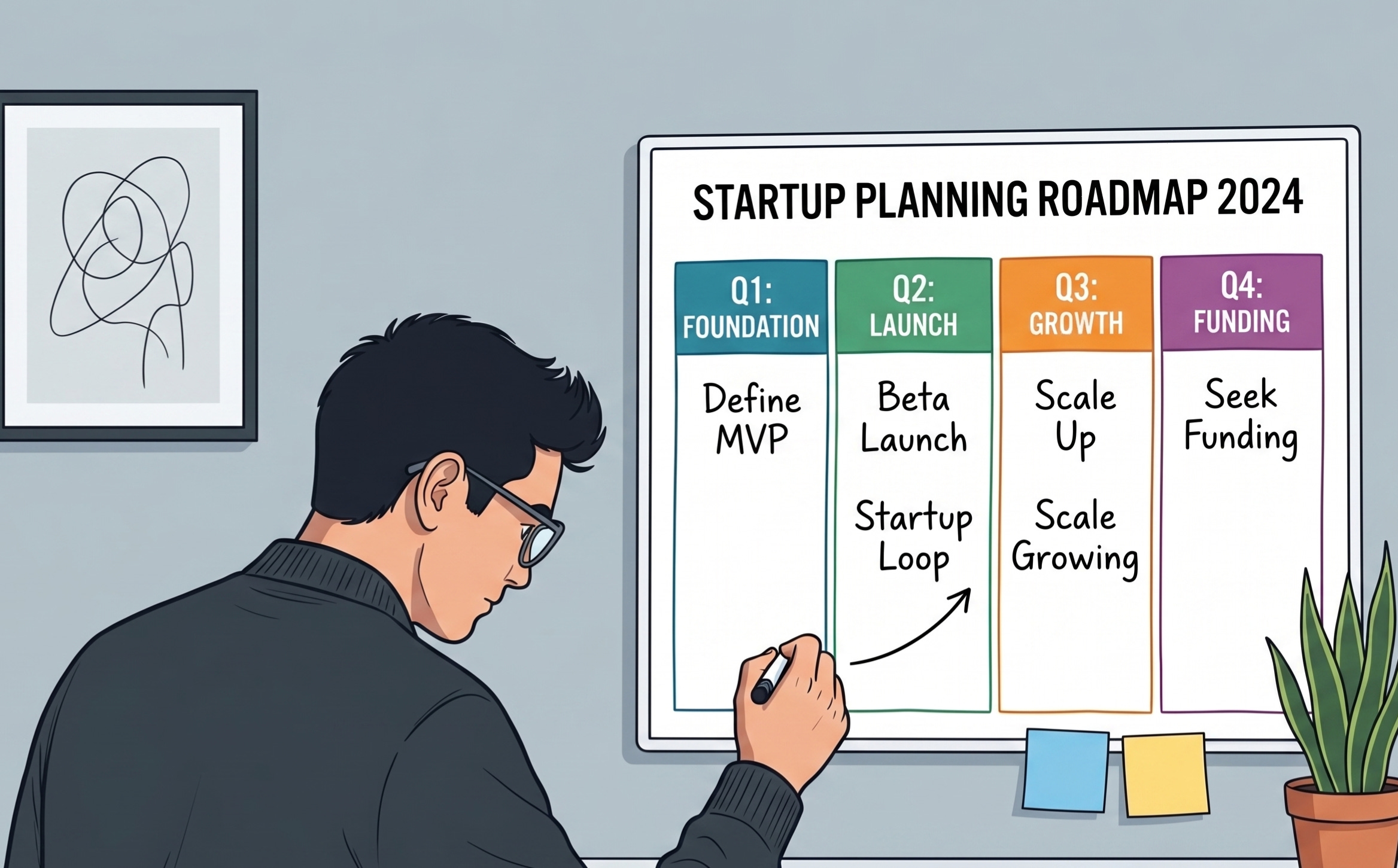
The annual goal trap
Here’s the standard playbook. The founder runs a planning retreat in January. Big whiteboard, big energy. Annual goals get written down. Everyone nods. The team goes back to work. By March, nobody remembers what the goals were. By July, they’re irrelevant because the business looks nothing like it did six months ago.
Annual goals are hard for three reasons.
Predicting twelve months out is nearly impossible at the early stages. Your market shifts, your customers shift, your team shifts. The plan you wrote in January is solving a problem that may not exist by Q3.
Surviving the present overwhelms whatever you wrote down. The fire in front of you always steals your mental energy from the goal in the deck.
And almost everyone on your team forgets the goals anyway. Which means they don’t shape behavior, which means they don’t actually do anything.
Start with quarterly goals instead
Three months is a horizon you can actually see. Pick three or four goals that will move the company forward in the next quarter. Make them SMART. Specific, measurable, achievable, relevant, time-bound. Review them in your staff meetings and 1:1s every week or two.
That’s the system. It’s not complicated. The complicated part is sticking with it long enough to get good at it.
You’re going to be bad at this for a while
Commit to four quarterly cycles before you decide whether it works.
In your first quarter, your goals will not actually be SMART. They’ll be vague aspirations dressed up as objectives. You’ll forget about them halfway through the quarter. That’s normal. Run it again.
Second quarter, change the dynamic. Ask each person on your leadership team to set their own quarterly goals that ladder up to the team goals. The ownership shifts. They’re not getting handed objectives anymore; they’re proposing them. This is also where the accountability piece we talked about in our latest blog post starts to compound. People own metrics they set themselves.
Keep iterating until your leadership team produces good quarterly goals on autopilot. That usually takes a year. Don’t rush it. Be patient with the process. Give yourself and your team grace as you figure this out.
Year two, three, and beyond
Once your leadership team is fluent in the quarterly cadence, you can start expanding the horizon.
Year two, layer on annual goals at a planning retreat, with Q1 goals rolling out from them. Push quarterly goal-setting one level deeper into the organization so the next layer down is doing what your leadership team did in year one.
Year three, you can stretch to three-year goals, with annual and quarterly cascading down. By that point, every person in the organization is setting quarterly goals that ladder up to the mission.
That’s what alignment and accountability actually look like in practice. Not a poster on the wall. A whole organization, top to bottom, setting and reviewing goals on the same cadence, all pointing at the same north star.
Why this works
Most founders try to start with 1-3 year goals because that’s the part that feels like real strategy. But long-range goals without quarterly discipline are just wishful thinking. And annual goals without a team that can execute on a quarterly cadence are just a slower version of the same problem.
You don’t graduate to longer planning horizons by force of will. You earn them by getting good at shorter ones first.
Build the cadence. The strategy comes after.