


Most founders are not lazy. Their teams are not lazy. Everyone is putting in real effort.
And yet, something is off. Decisions pile up at the top. People work hard but drift from the mission. Or worse: they’re aligned and motivated, but no one is actually empowered to move.
This is what partial ownership looks like. And it’s more common than full ownership culture by a wide margin.
At Wisdom Partners, we talk about three core elements that make ownership culture work: alignment, accountability, and autonomy. Underneath all three is a foundation of authenticity. Without that, none of it holds.
But here’s what most people miss. You don’t get the benefits of ownership culture by having one or two of those elements. The combination matters. And each incomplete version of the three produces a very specific, very recognizable dysfunction.
First, the definitions.
Alignment is when everyone understands the mission and how their work connects to it. They’re moving in the same direction.
Accountability is when everyone knows what they’re responsible for, how success will be measured, and there’s a predictable rhythm of checking in on that progress.
Autonomy is when people have the freedom to take decisive action within their area of responsibility. They know the limits of their authority, and they act within them without having to check back on every little thing.
When all three are present, you get acceleration. The company moves faster than any one person could drive it. People bring better ideas to the table than the CEO could have come up with alone. Key leaders own their domains and push them forward. The bottleneck at the top disappears.
But most companies don’t have all three. They have two. And two out of three always produces a problem.
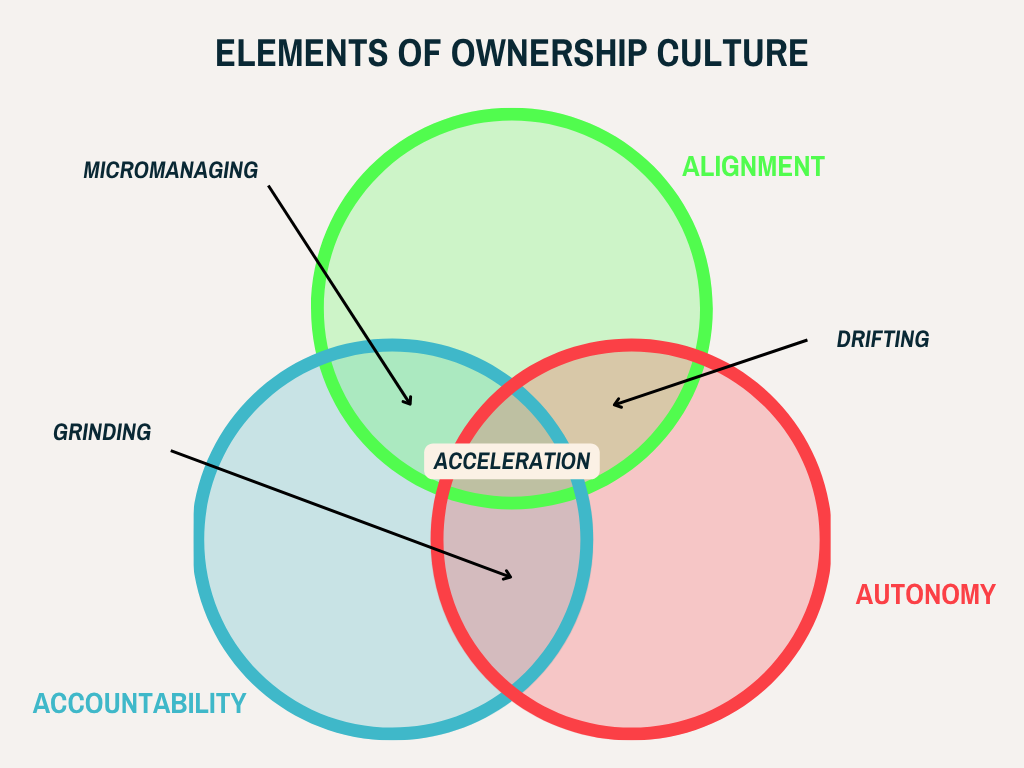
Alignment + Accountability, but no Autonomy: Micromanaging.
Everyone understands the mission. Everyone knows what they’re supposed to do and how it’s measured. But the leader is still making all the decisions. People can’t act without approval. The work moves at the speed of one person’s bandwidth.
This is one of the most common patterns we see in early-stage companies. The founder built a strong culture of clarity: people know the direction, they’re held to standards, but they never get permission to own it. The leader is the bottleneck, and everyone around them is waiting.
Accountability + Autonomy, but no Alignment: Grinding.
People know their numbers. They’re empowered to act. They’re working incredibly hard.
But they’re not working on the right things.
Without alignment, autonomy becomes fragmented effort. Accountability without a shared mission just means everyone is optimizing their own corner. You get a company full of motivated, capable people rowing in slightly different directions. It looks productive. It rarely compounds.
Alignment + Autonomy, but no Accountability: Drifting.
This one is sneaky. You can start out in a great place. But without accountability, alignment decays over time. Slowly. Quietly.
Some people even give the bad leadership advice: “Hire great people, and get out of the way.” But that just doesn’t work. You give people autonomy without a rhythm of checking in. And six months later, you look up and realize people have drifted away from the mission. Not because they’re bad. Because nothing was holding the direction steady.
All three together: Acceleration.
When alignment, accountability, and autonomy are all working, something shifts. The company starts to achieve things that surprise even the people inside it. Key leaders bring better solutions than the CEO could have designed alone. People are no longer waiting to be told, they’re driving.
No single person becomes a bottleneck. The organization scales beyond what any one person’s capacity could allow.
That’s the goal. Not just hard work. Not just good intentions. A system where ownership is real at every level.
The question worth sitting with: which two do you have right now? And what’s the one that’s missing?